Wednesday, September 14, 2011

Georgia (Wine) on my Mind


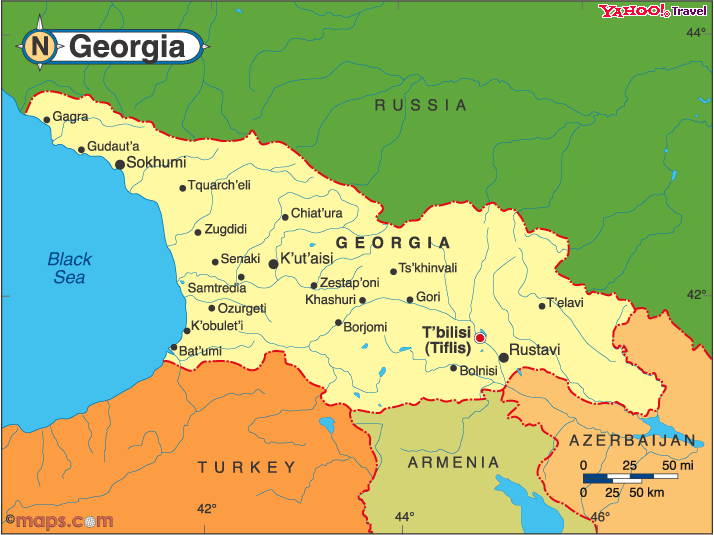
The country of Georgia is nestled in the southeastern corner of Europe, or is it the far western side of Asia? No matter, this country, about the size of Austria, has a rugged landscape defined by the dramatic Caucasus mountains, which boast the highest peak in Europe, Mount Elbrus (ah, so that’s a vote for Europe).
Formerly enclosed behind the iron curtain, this post-communist country is not well-known nor well traveled by Americans. Which is a shame, because this land offers its own magnificent brand of hospitality, so well expressed in the lines of their famous poet Rustaveli: Spending on feasting and wine is better than hoarding our substance; That which we give makes us richer, that which is hoarded is lost. In addition, the country has a fascinating, ancient tradition of making wine.
In fact, Georgia is considered by many to be the birthplace of wine. While some may consider the Romans or Greeks to be the first to ferment grapes, it’s simply not true. There is evidence of winemaking in Georgia dating back 5000-7000 years.
Now the country is determined to bring this ancient tradition into the modern world, looking to send its wines to export markets far beyond its borders.
I am pleased to announce that I am joining a select group of wine experts organized by 2020DC on a journey of a lifetime: seven days criss-crossing Georgia, visiting wineries, feasting at the rowdy and extravagant Supras, and learning about and documenting the state of Georgian wine. While internet may be scarce in the most rural pockets of the country, I will be tweeting and blogging as I can. When I return, my notes and photos will be made into articles distributed to a number of outlets – and I’ll make sure to include links of these in future blog posts.
For now, my mind and heart are turning eastward -- farther east in Europe than I have ever gone before. To the ancient land of mountains and wine. To Georgia.

Friday, August 19, 2011

TasteCamp 2011 Reveals Winning Ontario Wines


This spring a group of wine bloggers, primarily from the Northeastern U.S. and Eastern Canada, descended on the Niagara on the Lake wine region for the third annual TasteCamp. TC gives wine bloggers an intense weekend of wine tasting and education in wine regions that are not usually widely promoted. This year’s group was notably multilingual, as French Canadians joined the usual crowd of native English speakers.

On to the wines. I found a number of the white wines to be of very high quality. I enjoyed many Rieslings, most notably the single vineyard offerings from Thirty Bench. These had lovely minerality and lush tropical fruit flavors, a winning combination that I wholeheartedly recommend.

My wow wines of the trips were the Chardonnays. Being grown in a cold climate, the grapes achieve higher acidity than the same grapes from California, South Africa, or Australia, for example. It was this extra shot of acidity that brightened the classic Chardonnay flavors of apples and citrus and gave the wines a welcome liveliness. I am not the biggest fan of Chard, but these were very special. The offerings of Tawse Winery were most memorable.

Pinot Noir is another go-to grape for the Ontario winemakers, but I must say that many of these wines tasted green to me – did the grapes ripen adequately? To my palate, the answer was no. And yet, there were exceptions. Flat Rock Cellars did present some very pleasing Pinots, along with an interactive tour that included quizzes, and, most sensational, a sparkling wine that was not sabered, but axed! Very Canadian.

But no discussion of Ontario wine would be complete without mentioning their most famous offering: ice wine. Grapes are hand-picked after they have frozen on the vines. The juice that is pressed from these icy berries is thick and full of sugar. Once vinified, they are some of the world’s best dessert wines – and it is traditional to serve them chilled in cordial glasses. We tried dessert wines made from Vidal grapes (a common variety up north), from Riesling, and, most intriguing of all, one ice wine from Cabernet Sauvignon grapes, which was a lovely pink-amber color and tasted of strawberries.

In all, TasteCamp 2011 gave us a very good foundation in the joys of Ontario wine. In addition, the Niagara on the Lake area offers lovely rolling countryside and fine dining: our group was most impressed by the succulent lamb shanks that were the entree of our excellent dinner at Treadwell Farm to Table Cuisine. Throw in a visit to the Falls, and you have a perfect weekend wine destination from the northeast.

Thursday, June 2, 2011

Summer Wine Pairing Dinner in Maplewood June 28


I'll be pouring and presenting at a Summer Wine Pairing Dinner at Coda Kitchen and Bar on June 28 from 7-9 pm. The dinner is sponsored by the South Orange-Maplewood Adult School. I hope you can join me for an evening of good food and special summer wine pairings. To register for the dinner, which costs $63 plus a small registration fee, please visit the class page on the South Orange-Maplewood Adult School web site. Hope to see you there!

Tuesday, May 24, 2011

House of Esterhazy Launches Line of Austrian Wines in U.S.


The string quartet filled the air with Mozart. The apfelstrudel was sublime. But most of all, there were the wines. Brought from the land of waltzes and Alps, from the land where Hayden is still remembered with reverence. The House of Esterhazy poured their line of wines at Austrian-themed restaurant Blaue Gans in lower Manhattan at a recent event for members of the press and wine trade.
The estate of the aristocratic Esterhazy family is a castle located just a short ride outside of Vienna. Visitors can tour the magnificent house as well as step down into the old wine cellars, which boast huge wooden casks that have beautiful carvings on their façade. The contemporary winery is a short ride away. Here, glass and steel dominate the architecture, and this is where the modern wine-making magic happens.
I visited Esterhazy during the European Wine Bloggers Conference. Now the wines of this historic estate are available in the states. At the luncheon the following wines were poured:
- NV Blanc de Noirs – with a fresh nose of peaches, white pepper, and brioche, this was a refreshing sparkler
- 2010 Estoras Gruner Veltliner – from the Weinwertel region, this showed the signature peppery nose and flavors of Gruner, a good spring and summer wine
- 2008 Blaufrankisch Follig – a single vineyard wine with dark berries, grippy tannins
- 2008 Cuvee Trockenbeerenauslese – a dessert wine blended from Welchriesling and Pinot Blanc, with exotic fresh fruit flavors
I enjoyed the wines of this luncheon, and I can recommend Esterhazy as a fascinating destination for tourists who are visiting Vienna. One final note: while you can’t judge a book by its cover – or a wine by its label – I happen to love the Esterhazy wine labels. They feature historic paintings or artwork in a fresh modern design. Very much like the winery itself, which draws upon its centuries-old winemaking tradition while incorporating the best of current technology.

Thursday, May 5, 2011

Clearing the language hurdle to sell Austrian Wine

Last night at Austria Uncorked, a massive trade/consumer tasting at the sprawling event space TriBeCa rooftop, I noticed something funny on some of the wine labels – words that were not German.

For example, Hillinger poured a Pinot Noir-based sparkler that was full of ripe raspberry flavors, but it was not called by the German word Sekt, as I knew it normally would. Instead, it was referred to as “Secco.” When I asked why, I was told because people would think of Prosecco. It was an interesting choice, especially because wine aficionados also think of “sec” (the word for "dry" in French) as being a level of sweetness, a la Champagne. It was also at the Hillinger table where I encountered the word “Terroir” on the label – it was the name given to one of their high-end wines. That word's thrown around a lot, but here it just seems confusing, as the label tells you nothing about what the "terroir" is actually like--it's merely used as a buzz word.

I wonder if this language tinkering is necessary, because I think Hillinger has already tackled the "German" question with their innovative silver labeling and stylistic logo, and, most importantly their wines are really good. I understand that the German language is no picnic for the English speaking world, and that wine lovers in the international market are more likely to know about the popular Prosecco than Sekt. However, as a lover of language, I'm a little let down when I see this.

One brand that seems to successfully be jumping the German hurdle is Monica Caha wines, which have a great graphic representation of Austria's signature grape, Gruner Veltliner. I met Toni Silver, a New York-based representative for the brand and the model for the shouting "Grooner" girl, who appears on their wine labels and Twitter avatar. I like the way this company has taken the hard to pronounce Gruner Veltliner and shortened it in a fun way. At least we're still in the same language.

Another Austrian brand uses the "animal on the label" to cross the language barrier -Zantho. I also like this decision, because, not only is their lizard rendered in an artistic--not cutesy--way, but also because I know that this type of animal is unique to this part of Austria and therefore representative of the (there's that word again) terroir.

As someone who loves history and language, I appreciate traditional Austrian labels, such as are found on one of my favorite wine brands: Umathum. Their labels conjure up the romance of Europe and the tradition of the old world.

Still, I acknowledge that for the most part, it is a tough challenge to get Americans and the rest of the non-German speaking world to get beyond this complicated language to appreciate these wines. However, it's definitely a worthy goal, as Austrian wines have something very special to offer wine lovers.


Sunday, April 10, 2011

Ruinart Champagne Blanc de Blanc


I recently attended an evening sponsored by Ruinart Champagne at David Burke's newest venture, David Burke's Kitchen. More specifically, a dozen or so bloggers and I were invited upstairs to the bar, playfully named the Treehouse.
We were greeted with full glasses of the Champagne house's Blanc de Blanc. The name has everything to do with the color of the grapes used in the wine. Champagne traditionally is blend of wines: Chardonnay, Pinot Noir, and to a lesser degree, Pinot Meunier. The last two grapes are red grapes, and Chardonnay, of course we know as a white-wine grape.
However, at times Champagne makers choose to produce a sparkling wine from either all white, as in the case of Blanc de Blanc, or all red (also called "black") grapes, as in the case of Blanc de Noir.
And so I sipped the lovely Champagne that was distinctly more refreshing than the usual blend of white and red grapes. After chatting with the tall and charming head of Ruinart, Jean Marc Gallot, and mingling with my fellow bloggers, I headed to a formally-set table for some fun and games with scent.
Ruinart proposed that we wine and food bloggers consider the different aromas and flavors in their blanc de blanc Champagne. So, set before each of us was a small cylinder filled with seven tiny vials filled with liquid scent. We also each had a card of about 18 aromas and a sharpened pencil. And so it began. We unscrewed the top of each vial and sniffed. Was number 2 lemon and number 3 citron, or vice versa? The floral scent of jasmine was undeniable, and Jean Marc offered us a broad hint, "think of Sushi" that led us to ginger. Clues were hidden around the table decorations, and it turned out that one of the vials was pink peppercorns - look there was a glass bowl of them in front of us! We were not subject to the public scrutiny of reading our choices aloud (I was about 50% right), but the one who self-reported the most correctly identified scents did win a prize.
The better prize, however, was an evening full of Ruinart blanc de blanc and the daring cuisine of David Burke. After playing the scent game, the buttered toast, yellow apple of the Ruinart were clearer to me, along with hints of pineapple, and a nice lemon spritz on the back end. The fruit flavors were ripe, and the toasty flavors were delicious.
On to the dinner. The chef wowed us with a deep-friend grape filled with peanut butter appetizer, and a main course of crab cake lined with pretzel sticks - the salty crunch of the pretzels was a wonderful foil to the sweet crab. Lastly a delightul lollypop tree - orbs of different flavored cheesecakes dipped in white, milk, or dark chocolate and drizzled with flavors or dipped in crunchies.
At the end, we were delighted when celebrity Chef David Burke came upstairs and greeted us all. It was a stunning evening that was over too quickly. However, the ripe, layered fruit and toasty notes of the Ruinart were available to us any time we wanted a special champagne to savor.

Thursday, December 30, 2010

2010 - My year in wine


2010 marked my fourth year as a wine blogger and it was filled with highlights of travel, friendships, and spectacular events.

In early 2010, I enjoyed the delicious abbondanza of Vino 2010, an elaborate Italian wine festa at the Waldorf Astoria, where I waded through rooms full of Italian wine producers and enjoyed not one, but two, talks, by Anthony Giglio and managed to waltz across to Cipriani’s for Luca Maroni’s SensofWine on the same day.

At the end of the month, I bade a fond farewell to Italy-bound, Vineyard Adventuress Robbin Gheesling, and, along with Rob Bralow and Matt Sitomer and a few others, helped her finish off about nine bottles of vinous wonderfulness from her well-filled wine refrigerator (which I later took off her hands).

With spring came wine festival season, and I made the acquaintance of George Wilson and the gang from the St. Michael’s Winefest. After numerous emails and cell phone conversations on the fly, I was standing on board the Patriot on a fine May evening, gliding onto the Chesapeake Bay as I presented five wines during a lovely wine and food pairing cruise.

Also in May, was TasteCamp 2010, the second such blogger get-together that serves as a foil to the larger North American Wine Blogger Conference. Organized by the indefatigable Lenn Thomson, this year’s Taste Camp brought a few dozen bloggers (including my dear friend Melissa Dobson) and their significant others to the lovely Finger Lakes region in upstate New York for austere Rieslings and some very good Pinot Noir. My favorite visit was our last, to the small and welcoming wine cave of Heart and Hands Winery: their Pinot Noirs offered delicate fruit and earthy flavors – a lovely treat for someone with an old-world-leaning palate such as myself.

In June, the spirit of adventure turned me towards Europe again. During an hour long phone call from Rome, Robbin and I hatched the plan that I should come visit her in Amalfi. I’ll never forget our first stroll up the promenade to her favorite bar for a Spritz, an aperitivo comprised of Aperol bitter orange liquor, club soda and white wine. Nibbling on a bowl of nuts and watching the sunset over a steel blue Mediterranean, I couldn’t have been more content.

After zipping up and down the Amalfi coast on scenic ferry rides and scary bus rides--visiting the Marisa Cuomo winery, Pompeii and Positano--I left Italia for France, where I had signed up with Vitivinitours for Le Weekend des Grands Amatuers in Bordeaux.

On my first evening, I had the pleasure of dining with Jane Anson, her husband Frank, and a few of their fellow British ex-pats. We ate fresh oysters and drank (of all things) Prosecco on a picnic bench with a view of the Garonne River. Another magical evening of wine and friendship.

The next night proved how very small the wine world is, when I ran into Gregory Dal Piaz, the editor at Snooth and a New York City friend. Proving “there are no coincidences,” he and I were booked on the same trip that evening, an enchanting jaunt to Chateau Guiraud for a multi course dinner of superb cuisine and Bordeaux wines, ending with the Chateau’s own spectacular Sauternes.

Later that month, I faced a sore disappointment when I missed my flight to the west coast for what would have been my third North American Wine Bloggers Conference. I consoled myself by drinking a cult Cabernet Sauvignon and following the action on Twitter.

The summer saw some lovely get-togethers with other wine bloggers including the talented chef, Eric Guido, and two lovely NYC-based women of wine, Sasha Smith and Susannah Gold – hope to see all of them soon. And at a swanky Sonoma in the City event, I had the pleasure of meeting Carlo Devito, a wine-loving writer, blogger, and editor. In September, I was honored to be one of the bloggers invited to cover the Saratoga Wine and Food and Fall Ferrari Festival, where I was happy to catch up with my former teacher, Kevin Zraly, a man whose wine knowledge and charisma know no bounds.

As the leaves began to turn on the East Coast, my thoughts turned to Europe again, this time for a trip to Austria for the European Wine Bloggers Conference in Vienna. My last few trips had been to Italy, France, and Spain, where the lilt of Romance languages filled my days. Now, I was bound for the eastern fringe of Western Europe's traditional boundaries, where the hard “g” and clipped, mutli-syllables of German hold sway. I had traveled solo to Austria in my 20s and was eager to return to this majestic world capital.

EWBC felt like coming home in a way, as dozens of the friends I had made in 2009 in Lisbon were on hand again, including the lovely and intensely energetic, Gabriella Opaz. I cannot begin to describe the comradery and joie de vivre we wine-loving compatriots share, especially my wickedly clever pals, Denise Medrano and Andrew Barrow. This year, I made more friends: the witty Alistair Bathgate, the enthusiastic Eamon FitzGerald, the earthy and wonderful Caroline Henry, the well-liked-by-all wine student Prateek Arora, , and the swarthy Spaniard who lent me his arm for a waltz, Esteban Cabezas. I was also happy to hang out with my favorite Portuguese winemaker Oscar Quevedo, and, naturally, to drink some of his family's delicious port.

From Austria, I took a memorable train ride with Luiz Alberto, who accompanied me on my first foray into Eastern Europe: Budapest. There I was hosted by the gracious couple Carolyn and Gabor Banfalvi, who opened their home to me and fellow EWBCers, including the always intriguing Sam Ockman and two more Budapest dwellers, the charming Molly Havorka and her dynamic husband Zoli Piroska.

After two whirlwind days in the enchanting land of Tokai, I finished my Hungarian trip with a private lesson at the Central European Wine Institute at the invitation of another new friend, Gabor Patko.

As the cold weather swept into New York City, I began my next adventure in the world of wine: enrolling in the International Wine Center, the New York City branch of the internationally-recognized Wine and Spirits Education Trust, where I am applying myself diligently to the study of wine.

Thanks to everyone who made 2010 such a wonderful year of exploring new wines, new lands, and new adventures. I raise my glass to you.